Stay informed
SIWI newsletter
Receive SIWI’s latest news, events, reports and jobs directly in your inbox.
You can unsubscribe at any time.



The source-to-sea approach directly addresses the linkages along the source-to-sea continuum of land, water, delta, estuary, coast, nearshore and ocean ecosystems leading to holistic natural resources management and sustainable economic development.
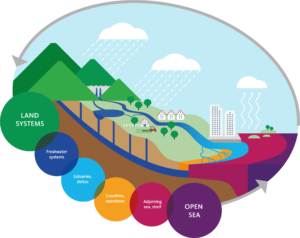
The intended outcome of the source-to-sea approach is to identify appropriate courses of action to address alterations of key flows that connect the source-to-sea segments: water, biota, sediment, pollution, materials, and ecosystem services. Doing so results in economic, social, and environmental benefits.
The approach begins with understanding the pressures and drivers that have led to alterations in the key flows. In combination with selecting an appropriate scale of intervention, engagement of stakeholders (both upstream and downstream) and a thorough understanding of the governance context sets the basis for defining a theory of change to guide planning and implementation. Monitoring and adaptive management round out the process and can be used to refine the theory of change and ensure continuous improvement toward long-term outcomes.