Stay informed
SIWI newsletter
Receive SIWI’s latest news, events, reports and jobs directly in your inbox.
You can unsubscribe at any time.

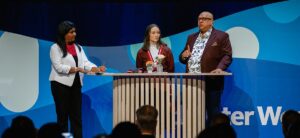
Aana is a board member in Sáminuorra, the Sámi national youth organization. The Sámi people are the Indigenous People who reside in Sápmi, which encompasses the northern parts of Sweden, Norway, Finland, and western Russia.
Phil is from Moree, North South Wales, and is a member of the Gomeroi Nation. His homelands are Moree and Terry Hie Hie. Phil has over 40 years’ experience working with Aboriginal people and the government through both his professional work and his active volunteer community work.
Aana: The concept of borders is made-up and not something that naturally exists. It stops us from working together, and it is something we need to work against. That’s why I think that the theme of this year is so important. In the end all of us are striving for the same goal: an earth we can live on with good waters and lands.
There’s also a border or gap in what’s at stake. For Indigenous Peoples, it [a healthy ecosystem] is a question about the existence of our people in the future. But for companies it might be more economic profit or growth in the short term. The fact that we don’t have the same perspectives creates a border.
This is what comes to my mind when thinking of borders and bridging them.
Phil: Three years ago, there were only five Indigenous Peoples represented at World Water Week, this year there are significantly more, the numbers are amazing. So, we have bridged that border of representation and the opportunity to amplify Indigenous Peoples’ voices globally.
My advice to other participants is to observe how we negotiate and see our vision through the eyes of future generations. And then approach discussions at World Water Week with a shared awareness, leaving your preconceived position at the door.
It’s important that we seize this opportunity of coming together at World Water Week, to look at how we bridge borders, not just territorially, but also in industry, government, and community, making Indigenous Peoples’ central to the dialogue and negotiations.
Communications Manager
radhika.gupta@siwi.org
The concept of borders is made-up and not something that naturally exists. It stops us from working together, and it is something we need to work against. That's why I think that the theme of this year is so important. In the end all of us are striving for the same goal: an earth we can live on with good waters and lands.
Phil: From my Indigenous perspective in Australia our stories are handed down to future generations. I am considered an Elder among my people and family, and I have the wonderful opportunity to not only hand down knowledge but to also learn from young people. It is about communication and respect, that is the foundation of life in any field.
We need to invest in tomorrow’s water and community leaders. For World Water Week 2025 we should have an Indigenous youth forum which could be a very fruitful gathering.
Aana: We as Indigenous Peoples have the thought of “us”, both elders and young people together and there is no border between us. We work together to minimize hierarchies, and the Elders see the youth as the future and at the same time as reflections of the past. They know that it is important to include us in both discussions and decisions, while also teaching us. We are a mirror of what has been and what’s to come.
Three years ago, there were only five Indigenous Peoples represented at World Water Week, this year there are significantly more, the numbers are amazing. So, we have bridged that border of representation and the opportunity to amplify Indigenous Peoples’ voices globally.
Phil: Global water systems are increasingly stressed by human and industry demands. The majority of our river systems are being dominated and degraded which means that the environment can no longer play its role in providing the ecosystem services that humans rely on.
I believe that the industry needs to have goodwill to look beyond engineering structures and look at what’s best for country and people first. How can the industry become inclusive and bring other people to the table for conversation? There are many opportunities to look at what we can achieve through multiple lenses.
We Indigenous Peoples exist in harmony with our cultural landscapes and keep tabs on water, and our ability to do so is intrinsically linked to our emotional health and longevity of life.
Aana: Those who need to take action are those in higher up positions of decision making. We Indigenous Peoples have our entire future at stake, and we are doing as much as we possibly can.
I work with Sámi health and Indigenous health topics, and I can see that these [environmental] challenges take everything from us. This is because our voices are not getting heard nor our knowledge respected.
Phil: We need to be respected as community leaders. Our knowledge and role should be recognized as key to [water and peace issues] and that we want to play that role. What works in Sweden may in many ways work in Australia too. There needs to be stronger platforms for such knowledge exchange, for us to share it globally and integrate that into decision making arenas on water management to take away conflict.
Aana: A common challenge is that our voices are not present in higher positions where we can influence decisions that affect us. Another challenge is of sustainability of water and keeping its good quality, while having access to it.
About common solutions, meeting other Indigenous during previous World Water Week conferences has made me bring home many thoughts on how other systems work and how they get influence over decisions. I have also learned about the importance of working together with the water sector – I think all Indigenous Peoples agree that we need open communication to be able to move forward.